
6F5 capping explained: what it is and when you can actually use it
6F5 is one of the cheapest ways to build a working platform over soft ground – and one of the easiest materials to specify in the wrong place. Here is what it is, where it belongs, and where it will cost you money.
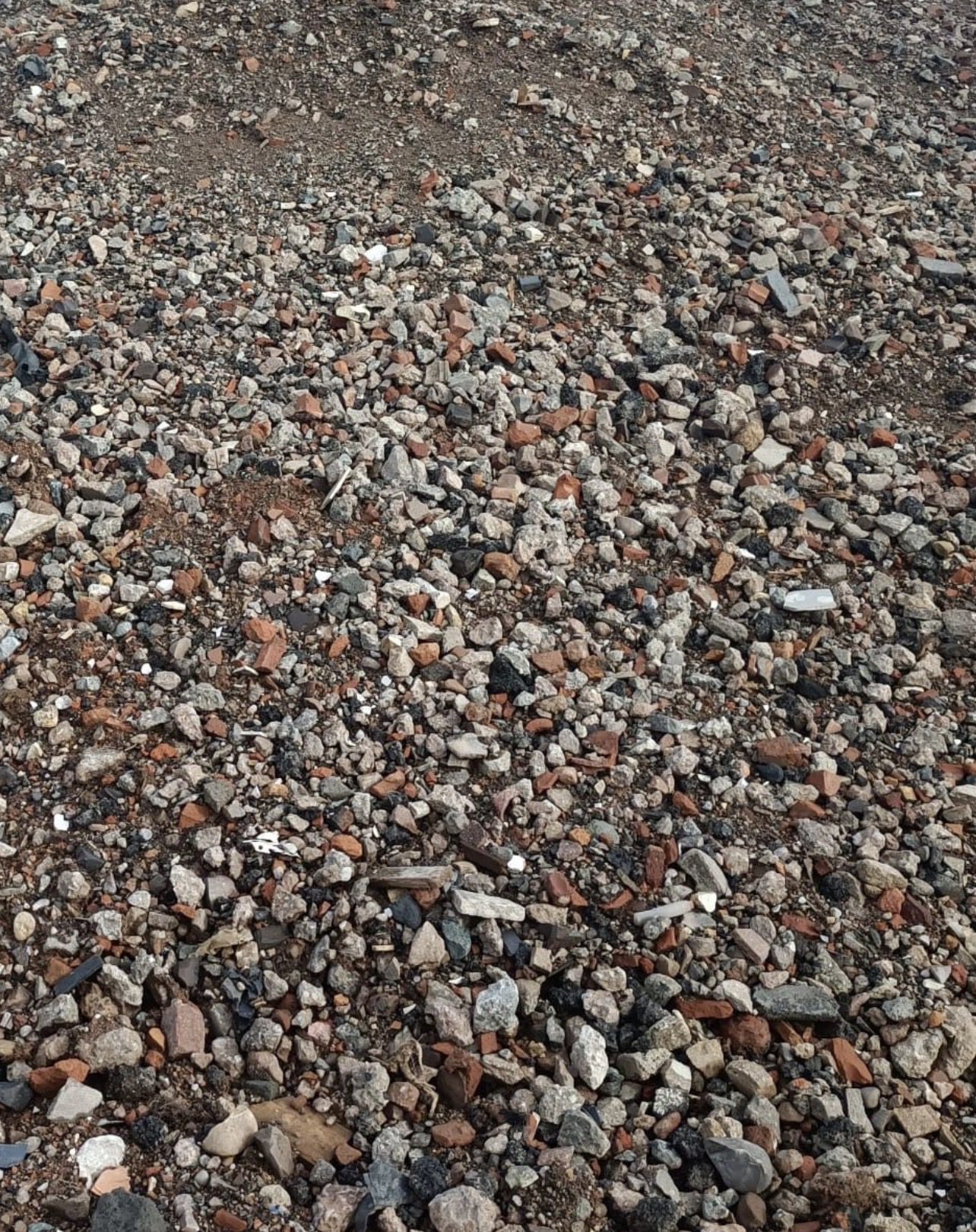
The single most useful thing to understand about 6F5 is what layer it belongs in. Get that right and it saves real money. Get it wrong and you have a coarse, oversized material sitting where it cannot do its job.
Capping is not sub-base
A road, yard or hardstanding is built in layers. From the bottom up: the subgrade, which is whatever ground you have; then, if the subgrade is weak, a capping layer; then the sub-base; then whatever surfacing goes on top.
Capping and sub-base do different jobs. Sub-base – usually Type 1 – is a well-graded material that compacts to a dense, load-spreading layer directly beneath the surfacing. Capping sits underneath it, and its job is to turn ground you cannot build on into a platform you can. It bridges soft spots, gives plant somewhere to run, and lets you reduce the sub-base thickness above it.
6F5 is a capping material. It is not a sub-base and it is not a finished surface.
What 6F5 actually is
6F5 is a coarse recycled granular material, specified in the earthworks series of the Specification for Highway Works. In practice it is crushed construction and demolition arisings – concrete, brick, block, sometimes asphalt planings – processed and graded rather than simply dug out and tipped.
The defining feature is particle size. 6F5 runs considerably coarser than Type 1, with a maximum size up around 125mm. That coarseness is exactly why it works as capping: large, angular pieces bridge and interlock over soft ground in a way a finer material cannot.
It is also why it is useless where you need tolerance. You cannot screed to a level on 125mm lumps, and you cannot lay block paving or a slab directly on it.
6F2 and 6F5 are both coarse capping materials of similar size. The practical difference is source: 6F5 is the recycled classification. Where a spec permits 6F5, it is usually the cheaper of the two – so it is always worth asking which the engineer will actually accept before ordering 6F2 by habit.
When capping is worth it
Capping earns its place when the subgrade is weak – broadly, when CBR values are low enough that building sub-base straight onto the ground would mean an uneconomic thickness, or would simply fail.
The economics are straightforward. Capping material is cheaper per tonne than sub-base. If a capping layer lets you take significant depth out of the Type 1 above it, you have swapped expensive material for cheap material and come out ahead – while getting a more robust build and a working platform your plant can actually use during construction.
| Layer | Typical material | Job it does |
|---|---|---|
| Surfacing | Tarmac, blocks, concrete | The finished running surface |
| Sub-base | Type 1 (0/31.5mm) | Dense load-spreading layer, laid to tolerance |
| Capping | 6F5 or 6F2 (up to 125mm) | Bridges weak subgrade, working platform |
| Subgrade | Existing ground | Whatever you’ve got – the reason capping exists |
Capping depth is a design decision, not a rule of thumb – it comes off the CBR value and the design traffic loading. Typical layers run from around 250mm on marginal ground up to 600mm where conditions are genuinely poor. If nobody has tested the ground, that is the thing to sort before ordering anything.
The paperwork question
Because 6F5 is recycled from demolition arisings, it carries a question that primary aggregate does not: what is actually in it.
Properly produced 6F5 comes from a permitted facility, is processed to meet the grading, and is produced under a quality protocol so that it counts as a product rather than a waste. That matters both for compliance and for what happens on your site – material that has not been through that process can carry contaminants, and putting it in the ground makes it your problem.
This is not a reason to avoid recycled material. It is a reason to know where yours comes from. We only source recycled aggregate from operators we have vetted, and the documentation follows the load. The same principle applies in reverse to material leaving your site – see contaminated soil disposal for how classification and WAC testing work.
If a price for 6F5 looks unusually cheap, ask which facility it came from and what documentation comes with it. Unprocessed demolition rubble sold as capping is the cheapest material on the market and the most expensive mistake.
Where people get it wrong
- Using 6F5 as sub-base – too coarse to compact to tolerance, and the surfacing above it will show it
- Using it where no capping is needed – on decent ground it is an extra layer doing nothing
- Ordering it because it’s cheap – without checking the spec permits recycled material for that layer
- Laying it too thick per lift – coarse material still needs compacting in layers
- Assuming all recycled crush is 6F5 – graded, documented material and general hardcore are not the same product
Getting it to site
Capping is a volume material, so the constraint is usually haulage and access rather than availability. On a big platform it is worth phasing deliveries against the earthworks programme so you are not storing hundreds of tonnes on a site that has nowhere to put it.
We supply 6F5, 6F2 and Type 1 through our bulk aggregate supply service across Wolverhampton, Walsall, Dudley, Birmingham, Coventry, Telford, Shrewsbury and Leicester. If you are not sure which layer needs which material, tell us what the ground is doing and what is going on top – that is usually a quicker conversation than reading the spec twice.
On a platform build the capping rarely arrives on its own. Stripping to formation, levelling and getting the spoil off site is groundworks and muck away, and running both against one programme is what stops a site sitting idle waiting on the next supplier.
Building over soft ground?
Tell us what the subgrade is doing and what’s going on top. We’ll tell you what the layer actually needs – and what it costs.