
MOT Type 1 explained: what it is, how deep, and how much you need
The most ordered aggregate in UK construction, and the one most often ordered wrong. Here is what the spec actually says, what depth your job needs, and how to work out the tonnage before you ring anyone.
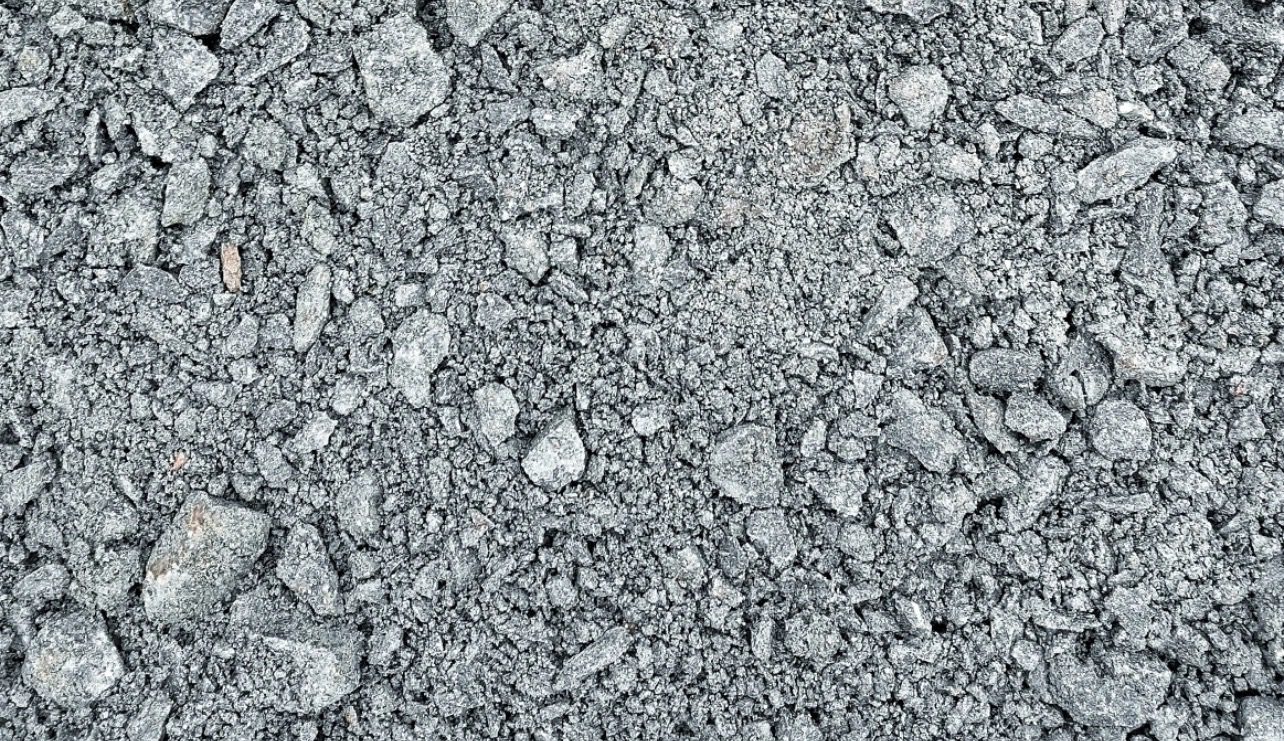
Ask ten people on site what MOT Type 1 is and you will get ten versions of “the grey crushed stuff that goes under everything”. Which is close enough to be useful and vague enough to cause problems – because Type 1 is a defined specification, not a generic description, and ordering the wrong thing means either paying over the odds or laying a sub-base that fails.
What MOT Type 1 actually is
MOT stands for Ministry of Transport, a department that has not existed since 1970. The name stuck. The material is now specified in the Specification for Highway Works, where it appears as a Type 1 unbound mixture under the Series 800 clauses.
What matters in practice is the grading. Type 1 is a well-graded crushed material running from around 31.5mm down to dust, with every size in between. That range is the whole point: the smaller particles fill the voids between the larger ones, so when you compact it the material locks together into a dense, load-bearing layer rather than shifting about under load.
It can be made from crushed rock, crushed concrete, crushed slag or other recycled aggregate. What it cannot be is a single-size stone, or a material with too many fines – the specification caps the very fine content to keep the layer free-draining and resistant to frost heave.
Asking for “Type 1” when what the job needs is capping. Type 1 is a sub-base. If your subgrade is soft, putting more Type 1 down is an expensive way to solve a problem that a capping layer solves for less. See our guide on 6F5 capping for where that line falls.
Quarried or recycled?
Both can meet the Type 1 grading. Quarried Type 1 is crushed virgin rock – limestone or granite, depending on the source. Recycled Type 1 is typically crushed concrete processed to the same grading envelope.
For a specified highway job, the engineer will usually call for a particular source and you follow the spec. For a driveway, a yard, a car park or a building slab, recycled Type 1 does the same job for less money, provided it is properly processed and graded rather than whatever came off the last demolition.
The honest answer is that the difference is more often about paperwork and specification than performance. If nobody has specified virgin material, ask about recycled – it is usually the cheaper answer and we will tell you when it is not appropriate.
How deep does it need to be?
Depth is driven by what is going on top and what is underneath. These are the depths that cover most jobs, assuming a reasonable subgrade:
| Application | Compacted depth | Notes |
|---|---|---|
| Patio, footpath, pedestrian only | 75-100mm | Over a firm, well-drained subgrade |
| Domestic driveway, cars only | 100-150mm | 150mm if the ground is soft or clay-heavy |
| Car park, light commercial vehicles | 150-225mm | Consider capping below if CBR is low |
| Yard, HGV traffic, plant movements | 225-300mm+ | Almost always wants a capping layer under it |
| Under a building slab | Per structural design | Follow the engineer, not a rule of thumb |
Compact in layers, not in one go. Anything more than about 150mm should be laid and compacted in separate lifts – a roller or plate will not properly densify a 300mm dump in a single pass, and what you get is a firm crust over a loose middle that settles the first time something heavy drives on it.
Working out how much to order
Compacted Type 1 sits at roughly 2.1 tonnes per cubic metre. That gives a usable rule:
- One tonne covers about 4.8m² at 100mm compacted depth
- One tonne covers about 3.2m² at 150mm compacted depth
- One tonne covers about 2.4m² at 200mm compacted depth
So a 60m² driveway at 150mm needs roughly 19 tonnes. Add around 10% for compaction losses and uneven formation and call it 21.
Work in tonnes, not “loads”. A load means different things depending on whether a grab, an 8-wheel tipper or an artic turns up. Tell us the tonnage and the site access and we will work out what can physically get in.
Where Type 1 goes wrong
Four failures account for most of the problems we get called out to:
- Laid too thick in one lift – looks compacted, is not, settles within months
- Laid on unprepared formation – Type 1 spreads load, it does not fix soft ground
- Contaminated with site spoil – clay worked into the sub-base destroys the drainage the grading was designed for. If the spoil coming out is questionable, get it tested and classified before it goes anywhere near the build-up
- Wrong material entirely – single-size stone or unscreened crush ordered because someone said “hardcore”
Getting it delivered
The practical constraints are usually access and timing rather than the material. A 20-tonne 8-wheel tipper needs room to tip; a restricted site may need smaller loads or a grab. Scheduled deliveries across a programme cost the same as one big drop and save you the stockpiling headache, which matters on a tight footprint.
We supply quarried and recycled Type 1 through our bulk aggregate supply service across Wolverhampton, Walsall, Dudley, Birmingham, Coventry, Telford, Shrewsbury and Leicester, from a network of vetted licensed operators rather than one tied source – so the price reflects what the market actually supports on the day.
If the sub-base is part of a wider job – strip out, level, drainage and back-fill – that usually sits better with our groundworks team handling the lot, with muck away booked against the same programme so the spoil leaves as the stone arrives.
Need Type 1 on site?
Tell us the tonnage, the depth or just the area – and the site access. We’ll come back with a price and a delivery that fits.