
Type 1 vs 6F2 vs 6F5: choosing the right sub-base
Three materials that get ordered interchangeably, cost very different amounts, and do very different jobs. Here’s what each one is actually for – and how to avoid paying granite prices for a capping layer.
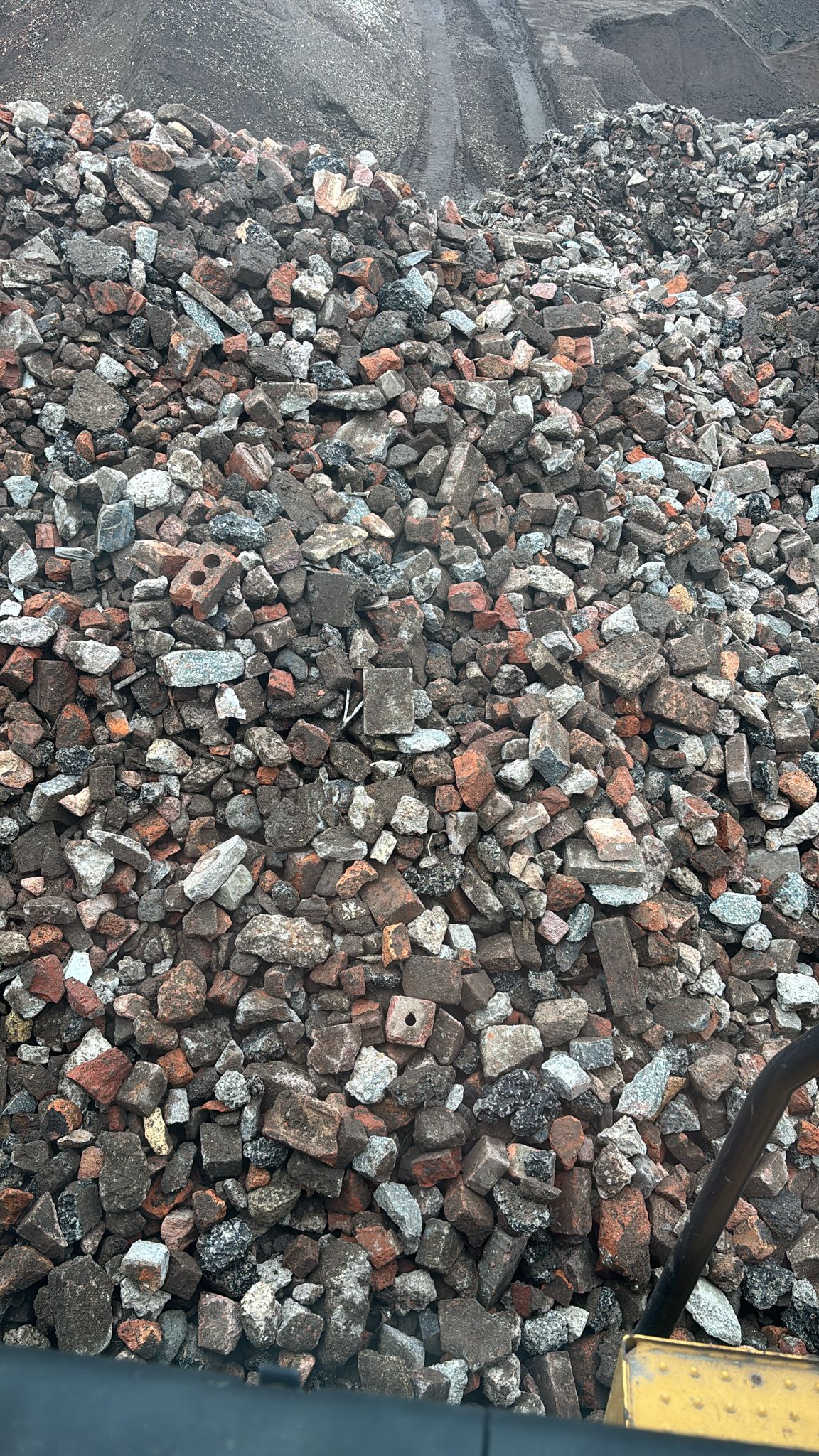
Ask three groundworkers what the difference is between Type 1, 6F2 and 6F5 and you’ll often get three answers – one confident, one vague, and one that’s simply “whatever the spec says.” The confusion costs money in both directions: people over-specify expensive primary stone where a capping layer would do, and occasionally under-specify where it genuinely matters.
Here’s the plain-English version.
Type 1 (MOT Type 1) – the load-bearing sub-base
Type 1 is the workhorse. It’s a graded crushed stone – typically granite or limestone – engineered so the particle sizes range from about 40mm down to dust. That grading is the whole point: the fines pack into the voids between the larger stones, so when it’s compacted it locks up and becomes a dense, stable, load-bearing layer.
It’s what goes directly beneath roads, car parks, hardstanding, footpaths, block paving and foundations – the layer that actually carries the load.
Crushed virgin stone. Consistent, certified, and specified where the engineer wants a known quantity. Granite is harder and more durable; limestone is generally cheaper and beds in well.
Crushed concrete and masonry, graded to the same envelope. Performs well for most applications, costs less, and carries real sustainability weight on tendered and public-sector work. Increasingly the default where the spec allows it.
Where the spec permits recycled, it’s usually the sensible call – you get the performance at a lower cost, and it helps on the recycled-content targets that come with a lot of tendered work these days.
6F2 – the capping layer
6F2 is a coarser, cheaper capping material. It’s a graded fill – larger particle sizes than Type 1, typically up to around 125mm – and it’s not a load-bearing sub-base. It’s what you put underneath the sub-base when the ground beneath is weak.
Its job is to bridge poor ground: it provides a working platform, spreads the load, and gets you a stable surface to build the proper sub-base on top of. It’s also frequently used for temporary haul roads and site access tracks, where you need something workable underfoot but don’t need engineered performance.
The expensive mistake: using Type 1 where 6F2 would do. If you’re capping soft ground or laying a temporary haul road, you’re paying a significant premium per tonne for engineered stone that’s doing a job cheaper fill would do just as well. On a large site, that difference adds up fast.
6F5 – the coarser cousin
6F5 is similar in purpose to 6F2 – a capping and fill material – but coarser again, with a larger maximum particle size. It’s used where you need bulk fill and a robust working platform over particularly poor ground, and where the finer grading of 6F2 isn’t necessary.
In practice, the choice between 6F2 and 6F5 often comes down to what the engineer has specified and what’s economically available locally. They do broadly the same job; 6F5 is the chunkier option.
The quick decision guide
- Load-bearing layer under a road, car park, slab or paving? Type 1.
- Bridging soft or weak ground before you lay the sub-base? 6F2 or 6F5.
- Temporary haul road or site access track? 6F2 – don’t waste Type 1 on it.
- Spec allows recycled? Take it. Same job, lower cost, better sustainability credentials.
- Engineer has specified a particular grade? Follow the spec – this guide helps you understand it, not override it.
A word on cost
Roughly speaking, the cost hierarchy runs: recycled Type 1 < 6F2/6F5 < quarried limestone Type 1 < quarried granite Type 1 – though local availability moves this around considerably. Haulage distance matters too: a quarry twenty miles further away can wipe out the saving on the stone itself.
That’s precisely why buying through an independent helps. We’re not tied to one quarry, so we source across a network of suppliers to find the right material at the best combination of price and haulage for your site – rather than pushing whatever stock a single supplier happens to be sitting on.
One more saving worth knowing: if you’re shifting spoil off site as well as bringing material in, backloading – taking muck out and bringing stone back on the same vehicle movement – meaningfully cuts your haulage bill. It’s one of the easiest savings on a groundworks job and it’s routinely missed.
Getting it delivered
We supply the full range – quarried and recycled Type 1, 6F2, 6F5, crushed concrete, ballast, sand and single-size stone – loose-tipped by tipper or bulk artic, in whatever quantity the job needs, across the Midlands.
More on our bulk aggregate supply and muck away and grab hire services – and if you’re not sure which material your job actually needs, just ask.
Not sure what to order?
Tell us the job, the ground and the quantity – we’ll tell you what you actually need and price it competitively.